
Gli effetti del cambiamento climatico sulla produttività aggregata. Il cambiamento climatico è una delle sfide politiche più urgenti del nostro tempo, occupando un posto centrale sia nel dibattito pubblico che nell’analisi economica. I dibattiti politici si concentrano spesso sul compromesso tra i costi a breve termine della riduzione delle emissioni di carbonio e i benefici a lungo termine della mitigazione del cambiamento climatico. Il contributo fondamentale di Nordhaus (1977) ha evidenziato l’importanza delle perdite di produttività aggregata dovute al cambiamento climatico nel delineare questo compromesso intertemporale. Tuttavia, quantificare accuratamente queste perdite rimane difficile e continua a essere un tema centrale nella letteratura accademica. Nonostante i progressi significativi, molte stime trascurano il ruolo delle imprese e gli ostacoli che ne limitano il comportamento nell’amplificare o mitigare le perdite aggregate. Colmare questa lacuna nei dati è fondamentale per la progettazione di politiche climatiche efficaci, soprattutto ora che i governi considerano obiettivi sempre più ambiziosi, come quelli definiti nei recenti vertici COP e nel Green Deal dell’UE.
Uno degli effetti del cambiamento climatico è l’aumento delle temperature globali, causato dall’aumento delle emissioni di carbonio. Questa tendenza impone perdite dirette di produttività alle aziende, poiché il caldo estremo riduce l’efficienza dei lavoratori, aumenta l’assenteismo e compromette le prestazioni dei macchinari (Heal e Park, 2016; Seppänen et al., 2006; Somanathan et al., 2021). Sebbene questi effetti diretti siano sostanziali, vi sono effetti indiretti altrettanto importanti, ma spesso trascurati. Questi effetti indiretti derivano dalla limitata capacità delle aziende di adattare gli input in modo efficiente in risposta agli shock climatici. Attriti a livello aziendale, come elevati costi di adeguamento, vincoli finanziari e l’incapacità di sostituire il capitale con il lavoro, possono limitare gravemente questa flessibilità.
Ad esempio, quando le aziende incontrano ostacoli alla riduzione degli input di capitale, sono costrette a trattenere il capitale in eccesso durante i periodi di ridotta attività. Ciò riduce la produttività marginale a causa dei rendimenti decrescenti. Per illustrare come tali attriti si trasformino in perdite di produttività, si consideri l’esempio di un evento di temperatura estrema che colpisce metà di un paese, causando l’inattività delle aziende locali per il 20% del tempo, con conseguente calo del 20% della produzione. In un’economia senza attriti, in cui non costa nulla alle imprese adeguare gli input e possono operare con rendimenti di scala costanti, la produttività aggregata rimarrebbe invariata, poiché input e output si contraggono nella stessa misura. Tuttavia, se le imprese non interessate possono aumentare la produzione mentre quelle interessate non sono in grado di adeguare l’utilizzo degli input, l’economia subisce un’errata allocazione delle risorse. Il risultato è un calo della produttività aggregata dovuto a un effetto indiretto (ovvero, gli input sono assegnati in modo inefficiente tra le imprese).
Nello scenario sopra descritto, questo calo sarebbe di circa il 10%. L’esempio evidenzia come le frizioni a livello aziendale possano amplificare le conseguenze economiche complessive degli shock climatici. Questo è importante anche per i modelli di valutazione integrata (Integrated Assessment Models, IAM), che spesso astraggono dai dettagli microeconomici, sottostimando potenzialmente i reali costi economici del cambiamento climatico.
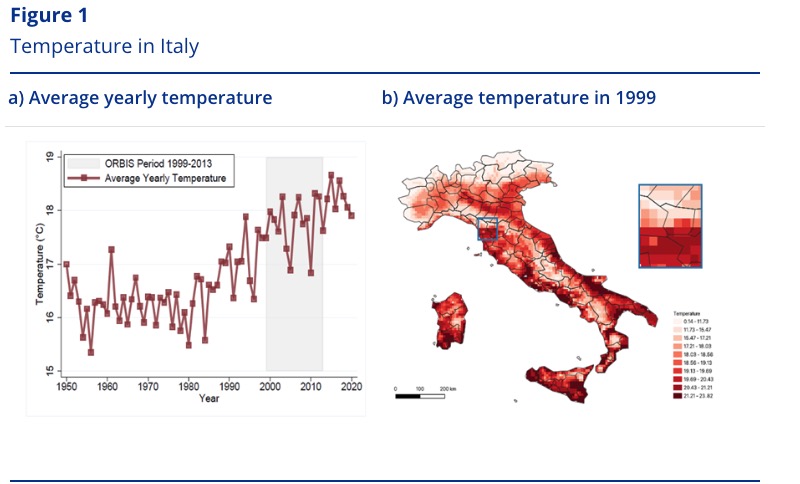
Nel nostro recente articolo (Caggese et al., 2025), abbiamo esaminato gli effetti diretti e indiretti delle temperature estreme sulle performance aziendali. Abbiamo ottenuto questo risultato combinando microdati dettagliati sulle aziende italiane con registrazioni di temperatura ad alta risoluzione provenienti dal dataset Copernicus E-OBS dell’UE. La diversificata geografia climatica ed economica dell’Italia, che si estende dai poli industriali alpini del Nord alle regioni più calde e meno industrializzate del Sud, offre un laboratorio naturale ideale per studiare le conseguenze economiche delle variazioni di temperatura. La Figura 1, pannello a) illustra l’evoluzione delle temperature massime medie in Italia, rivelando sia una significativa volatilità annua che una chiara tendenza al rialzo. La Figura 1, pannello b) mostra la distribuzione geografica delle temperature medie annuali nel 1999 in unità geografiche molto dettagliate, utilizzando la Nomenclatura delle unità territoriali per la statistica (NUTS), il sistema UE per la suddivisione dei paesi in regioni a fini statistici. L’ampio intervallo di temperature medie, da 0,14 °C a 23,82 °C, evidenzia le grandi differenze tra le regioni e conferma l’idoneità dell’Italia per l’analisi.
////
The effects of climate change on aggregate productivity
Climate change is one of the most pressing policy challenges of our time, occupying a central place in both public discourse and economic analysis. Policy debates frequently focus on the trade-off between the near-term costs of reducing carbon emissions and the long-term benefits of mitigating climate change. The seminal contribution by Nordhaus (1977) highlighted the importance of aggregate productivity losses from climate change in shaping this intertemporal trade-off. However, accurately quantifying these losses remains difficult and continues to be a central topic in the academic literature. Despite significant progress, many estimates overlook the role of firms and the barriers that constrain their behaviour in amplifying or mitigating aggregate losses. Bridging this data gap is crucial for designing effective climate policy, especially as governments consider more and more ambitious targets, such as those set out in recent COP summits and the EU Green Deal.
One effect of climate change is the increase in global temperatures driven by rising carbon emissions. This trend imposes direct productivity losses on firms, as extreme heat reduces worker efficiency, raises absenteeism and impairs machinery performance (Heal and Park, 2016; Seppänen et al., 2006; Somanathan et al., 2021). While these direct effects are substantial, there are indirect effects which are equally important but often overlooked. These indirect effects come from the limited ability of firms to adjust inputs efficiently in response to climate shocks. Firm-level frictions, such as high adjustment costs, financial constraints and the inability to substitute labour for capital, can severely restrict this flexibility. For instance, when firms face barriers to scaling down capital inputs, they are forced to keep excess capital during periods of reduced activity. This diminishes its marginal productivity due to decreasing returns. To illustrate how such frictions turn into productivity losses, consider the example of an extreme temperature event that affects half of a country, causing firms there to be non-operational for 20% of the time, resulting in a 20% drop in their output. In a frictionless economy where it costs firms nothing to adjust inputs and firms can operate under constant returns to scale, aggregate productivity would stay the same, as inputs and outputs contract to the same extent. However, if unaffected firms can increase production while affected firms are unable to adjust their input use, the economy experiences a misallocation of resources. The result is a decline in aggregate productivity owing to an indirect effect (i.e. inputs are inefficiently assigned across firms).[
2
]In the above scenario, this decline would be roughly 10%. The example highlights how firm-level frictions can magnify the overall economic consequences of climate shocks. This is also important for Integrated Assessment Models, which often abstract from microeconomic detail, potentially underestimating the true economic costs of climate change.
In our recent paper (Caggese et al., 2025), we examined both the direct and indirect effects of extreme temperatures on firm performance. We achieved this by combining detailed microdata on Italian firms with high-resolution temperature records from the EU’s Copernicus E-OBS dataset. Italy’s diverse climatic and economic geography – spanning from Alpine industrial hubs in the North to the warmer, less-industrialised regions in the South – provides an ideal natural laboratory for studying the economic consequences of temperature variation. Figure 1, panel a) illustrates how average maximum temperatures have evolved across Italy, revealing both significant year-on-year volatility and a clear upward trend. Figure 1, panel b) displays the geographical distribution of average annual temperatures in 1999 across very detailed geographic units using the Nomenclature of territorial units for statistics (NUTS), the EU system for subdividing countries into regions for statistical purposes. The wide range of average temperatures, from 0.14°C to 23.82°C, highlights the large differences between regions and confirms how suitable Italy is for the analysis.
What is the effect of temperature on firm performance?
Our analysis uncovers a significant direct effect of extreme heat on firm performance. Episodes of very high temperatures reduce sales by approximately 0.8%, with each additional day above 40°C equivalent to nearly two days of lost sales. In response to these conditions, firms substantially reduce labour and material inputs but notably do not adjust their capital usage (Figure 2, panel a). This rigidity is likely driven by high adjustment costs and other firm-level frictions, leading to an inefficient allocation of capital and a decline in its marginal productivity. For example, we find that a factory significantly scales back its production activity during periods of extreme heat. To cope with this reduced output, it cuts down on workers’ shifts and temporarily reduces raw material purchases. However, its machinery, cooling systems and physical infrastructure remain unchanged. These capital assets are costly to adjust or relocate, so they sit underused. As a result, the factory’s capital is not being deployed efficiently and the return on that investment – its marginal productivity – declines. To illustrate how this inability to reallocate capital contributes to productivity losses, Figure 2, panel b) shows the effect of temperature on the marginal product of different inputs. In a frictionless setting, aggregate productivity rises as inputs flow to firms that can use them the most efficiently, i.e. firms with the highest marginal returns. We also find that the marginal productivity of labour and materials remains relatively stable, reflecting the ability of firms to adjust these inputs flexibly. In contrast, the marginal productivity of capital declines sharply at high temperatures, indicating that firms are unable to shed excess capital when it becomes unproductive. We refer to these inefficiencies in capital use and the associated productivity losses as the indirect effects of temperature shocks.
What are the aggregate implications of climate change?
To quantify the aggregate implications of these micro-level direct and indirect effects, we have developed a model that maps estimated firm-level semi-elasticities of sales and input use to temperature changes. To estimate how climate change affects overall productivity, we need to consider three main factors: how firm productivity responds to temperature, how firms’ use of inputs like labour and materials changes with temperature and how temperatures are expected to change. We use our empirical results to quantify the first two factors, and we compute counterfactual scenarios of potential temperature increases. This framework allows us to break down aggregate productivity effects into two components: changes driven by efficiency losses within firms and changes arising from misallocation across firms. Our new approach reveals differences compared with previous research. Under a moderate scenario involving a 2°C increase in average annual temperatures, our model predicts a 1.68% decline in aggregate productivity. This decline is more than four times the 0.39% loss that is estimated using a naïve approach, which is a basic method that averages firm-level effects without considering economics factors like allocative distortions. These effects become even more pronounced under an increase of 4°C, with productivity losses rising to approximately 6.81%, which emphasises how climate shocks can have complex effects that can intensify existing problems (Figure 3).
We conclude by examining two scenarios that could either amplify or mitigate the effects of climate change. First, we assess the role of firm-level adaptation. By comparing regions with a long history of exposure to extreme temperatures – where firms are more likely to have already adopted climate‑resilient technologies – with regions that have only recently started to experience such temperatures, we find evidence that adaptation can substantially reduce the economic impact of heat shocks. Specifically, the use of climate-mitigating technologies lowers estimated damages by 20-30%. Second, we construct aggregate damage functions at the NUTS 3 level to evaluate the regional distribution of climate-induced productivity losses across Italian provinces. This geographical analysis reveals considerable variation, with effects ranging from mildly positive to severely negative (Figure 4, panel a). Notably, provinces with lower GDP per capita are projected to experience greater temperature increases, suggesting that climate change is likely to make existing regional disparities worse. Figure 4, panel b) plots projected productivity losses against regional GDP per capita, revealing that wealthier regions tend to incur smaller productivity losses, while poorer regions are more severely affected.
We conclude by examining two scenarios that could either amplify or mitigate the effects of climate change. First, we assess the role of firm-level adaptation. By comparing regions with a long history of exposure to extreme temperatures – where firms are more likely to have already adopted climate‑resilient technologies – with regions that have only recently started to experience such temperatures, we find evidence that adaptation can substantially reduce the economic impact of heat shocks. Specifically, the use of climate-mitigating technologies lowers estimated damages by 20-30%. Second, we construct aggregate damage functions at the NUTS 3 level to evaluate the regional distribution of climate-induced productivity losses across Italian provinces. This geographical analysis reveals considerable variation, with effects ranging from mildly positive to severely negative (Figure 4, panel a). Notably, provinces with lower GDP per capita are projected to experience greater temperature increases, suggesting that climate change is likely to make existing regional disparities worse. Figure 4, panel b) plots projected productivity losses against regional GDP per capita, revealing that wealthier regions tend to incur smaller productivity losses, while poorer regions are more severely affected.