
(Il testo seguente è tratto integralmente dalla nota stampa inviata all’Agenzia Opinione) –
///
Frontex: I passaggi irregolari alle frontiere dell’UE diminuiscono del 37% nel primo semestre 2026
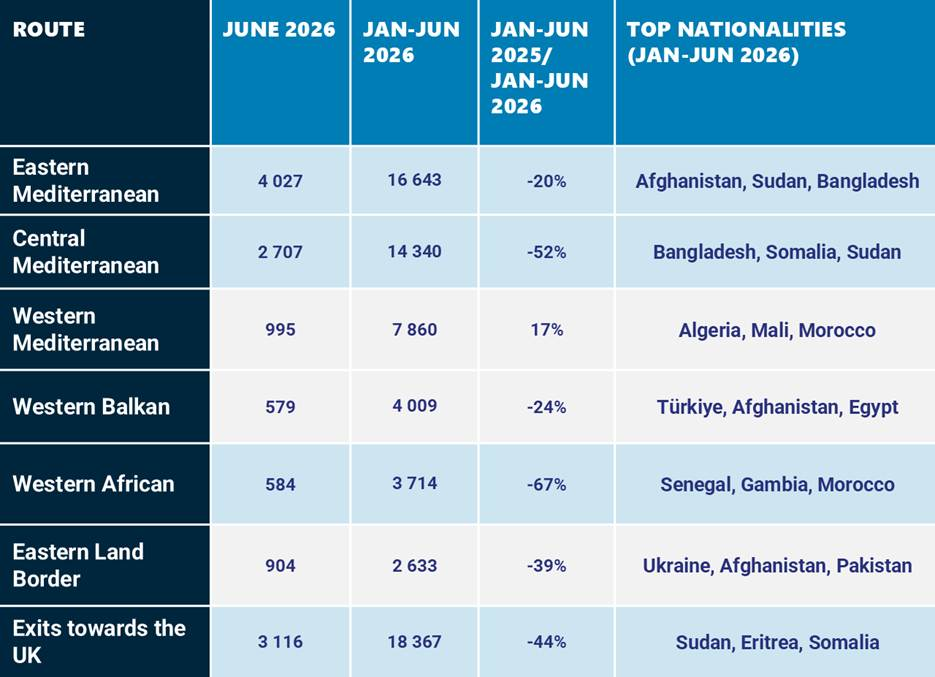
Il numero di passaggi irregolari alle frontiere dell’Unione europea ha continuato a diminuire nei primi sei mesi del 2026, con i rilevamenti in calo del 37% rispetto allo stesso periodo dell’anno scorso. Sono stati registrati più di 49.000 passaggi, secondo i dati preliminari raccolti da Frontex. Il declino riflette la cooperazione sostenuta con i paesi partner e le misure preventive negli stati di partenza chiave, che continuano a ridurre il numero di imbarcazioni in partenza verso l’Europa.
Nel primo semestre dell’anno è entrato in vigore anche il Patto dell’UE sulla migrazione e l’asilo, che introduce un processo di screening unico e standardizzato alle frontiere esterne dell’UE. Gli ufficiali di Frontex supportano gli stati membri nei passaggi chiave del nuovo processo, inclusa l’identificazione della nazionalità degli arrivi, la raccolta dei dati biometrici e la verifica dei documenti.
“Meno imbarcazioni stanno partendo verso l’Europa, e questo è il risultato della cooperazione sostenuta con i nostri partner nella regione. Ma dietro ogni numero c’è una persona, e le persone stanno ancora morendo in mare. I nostri ufficiali rimangono sul terreno alle frontiere esterne, supportando gli stati membri e aiutando a salvare vite,” ha dichiarato il direttore esecutivo di Frontex Hans Leijtens.
Punti salienti:
Il Mediterraneo orientale e il Mediterraneo centrale erano i percorsi più trafficati, rappresentando insieme più del 60% di tutti gli ingressi irregolari nell’UE.
La rotta dell’Africa occidentale ha registrato il calo più ripido, con i rilevamenti in diminuzione del 67% rispetto allo stesso periodo dell’anno scorso.
Il Mediterraneo occidentale era l’unico percorso principale a registrare un aumento, con i rilevamenti in aumento del 17%, guidati principalmente dalle partenze dall’Algeria.
Il numero complessivo degli arrivi irregolari continua a diminuire, ma il costo umano rimane elevato. Secondo l’Organizzazione internazionale per le migrazioni, quasi 1.300 persone hanno perso la vita nel Mediterraneo finora quest’anno. Ognuna di queste morti è un promemoria dei rischi a cui le persone sono costrette a sottoporsi. Le reti di traffico di esseri umani continuano a inviarle in mare su imbarcazioni sovraffollate e innavigabili, indipendentemente dalle condizioni.
La situazione in Medio Oriente rimane una fonte di incertezza per il panorama migratorio dell’UE. L’accordo di cessate il fuoco raggiunto a giugno suscita speranze di una graduale stabilizzazione in tutta la regione, ma il conflitto ha sfollato un gran numero di persone, e le sue conseguenze economiche più ampie rischiano di rafforzare le pressioni migratorie nella regione e oltre. Finora, questo non si è tradotto in un cambiamento significativo alle frontiere esterne dell’UE, ma Frontex continua a monitorare gli sviluppi da vicino.
Con 3.800 ufficiali presenti alle frontiere esterne dell’UE, Frontex continua a supportare le autorità nazionali nella salvaguardia delle frontiere europee e nel salvataggio di vite in mare.
Percorsi più attivi
Il Mediterraneo orientale è stato il percorso più trafficato nei primi sei mesi dell’anno, con più di 16.600 passaggi registrati, un calo del 20% rispetto allo stesso periodo dell’anno scorso. Il corridoio dalla Libia a Creta è rimasto il più attivo sulla rotta, rappresentando più della metà di tutti i rilevamenti, davanti alle frontiere terrestri con la Turchia e agli arrivi nelle isole dell’Egeo. Gli arrivi sui corridoi marittimi dalla Libia e dalla Turchia dovrebbero continuare ad aumentare con il miglioramento delle condizioni meteorologiche durante l’estate.
Il Mediterraneo centrale ha registrato circa 14.300 arrivi, meno della metà del totale dello stesso periodo dell’anno scorso. La Libia è rimasta il principale punto di partenza, dove i rinnovati scontri tra gruppi armati nella città costiera di Al-Zawiya hanno sottolineato la fragilità della situazione di sicurezza lungo la costa occidentale. Le principali nazionalità rilevate erano bangladesi, somale e sudanese.
Il Mediterraneo occidentale è stato l’unico percorso principale a registrare un aumento, con circa 7.900 rilevamenti, in aumento del 17% anno su anno. L’Algeria è rimasta il principale paese di partenza, e le isole Baleari sono state la destinazione più mirata, rappresentando quasi la metà di tutti gli arrivi sulla rotta. L’aumento riflette uno spostamento delle rotte di traffico, poiché i controlli più severi in Marocco e sulle rotte adiacenti dell’Africa occidentale e del Mediterraneo centrale hanno spinto più partenze verso le coste algerine.
La rotta dell’Africa occidentale ha registrato circa 3.700 rilevamenti, il calo più ripido di tutte le rotte al 67%. Le misure preventive attuate dalla Mauritania, e più recentemente da Senegal e Gambia in cooperazione con la Spagna e l’UE, hanno ridotto significativamente le partenze. Il flusso rimane tuttavia volatile: le condizioni del mare favorevoli hanno guidato un aumento stagionale delle partenze verso le isole Canarie, e l’incertezza politica in Senegal potrebbe aggiungere pressione migratoria nei prossimi mesi.
I tentativi rilevati in uscita verso il Regno Unito attraverso il Canale, che includono sia coloro che hanno raggiunto il Regno Unito sia coloro che sono stati impediti di partire, sono diminuiti del 44% a circa 18.400. L’accordo tra il Regno Unito e la Francia firmato ad aprile dovrebbe rafforzare ulteriormente le pattuglie lungo la costa francese nei prossimi mesi.
—
Frontex: Irregular border crossings into the EU down 37% in the first half of 2026
The number of irregular border crossings into the European Union continued to fall in the first six months of 2026, with detections down by 37% compared with the same period last year. More than 49,000 crossings were recorded, according to preliminary data collected by Frontex. The decline reflects sustained cooperation with partner countries and preventive measures in key departure states, which continue to reduce the number of boats setting out towards Europe.
The first half of the year also saw the entry into effect of the EU Pact on Migration and Asylum, which introduces a single, standardised screening process at the EU’s external borders. Frontex officers support member states in key steps of the new process, including establishing the nationality of arrivals, collecting biometric data and verifying documents.
“Fewer boats are setting out towards Europe, and that is the result of sustained cooperation with our partners in the region. But behind every number is a person, and people are still dying at sea. Our officers remain on the ground at the external borders, supporting member states and helping to save lives,” said Frontex Executive Director Hans Leijtens.
Key highlights:
The Eastern Mediterranean and the Central Mediterranean were the busiest routes, together accounting for more than 60% of all irregular entries into the EU.
The Western African route saw the steepest decline, with detections down by 67% compared with the same period last year.
The Western Mediterranean was the only major route to record an increase, with detections up by 17%, driven mainly by departures from Algeria.
The overall number of irregular arrivals continues to fall, but the human cost remains high. According to the International Organization for Migration, nearly 1,300 people have lost their lives in the Mediterranean so far this year. Each of these deaths is a reminder of the risks people are pushed to take. Smuggling networks continue to send them to sea in overcrowded and unseaworthy boats, whatever the conditions.
The situation in the Middle East remains a source of uncertainty for the EU’s migration landscape. The ceasefire agreement reached in June raises hopes of a gradual stabilisation across the region, but the conflict has displaced large numbers of people, and its wider economic consequences risk reinforcing migration pressures in the region and beyond. So far, this has not translated into a significant change at the EU’s external borders, but Frontex continues to monitor developments closely.
With 3,800 officers present at the EU’s external borders, Frontex continues to support national authorities in safeguarding Europe’s borders and saving lives at sea.
Most active routes
The Eastern Mediterranean was the busiest route in the first six months of the year, with more than 16,600 crossings recorded, a fall of 20% compared with the same period last year. The corridor from Libya to Crete remained the most active on the route, accounting for more than half of all detections, ahead of the land borders with Türkiye and arrivals in the Aegean islands. Arrivals on the sea corridors from Libya and Türkiye are expected to continue rising as weather conditions improve over the summer.
The Central Mediterranean recorded around 14,300 arrivals, less than half the total from the same period last year. Libya remained the main departure point, where renewed clashes between armed groups in the coastal city of Al-Zawiya underlined the fragility of the security situation along the western coast. The main nationalities detected were Bangladeshi, Somali and Sudanese.
The Western Mediterranean was the only major route to register an increase, with around 7,900 detections, up by 17% year-on-year. Algeria remained the main departure country, and the Balearic Islands were the most targeted destination, accounting for nearly half of all arrivals on the route. The rise reflects a shift in smuggling routes, as stricter controls in Morocco and on the neighbouring Western African and Central Mediterranean routes have pushed more departures towards Algerian shores.
The Western African route registered around 3,700 detections, the steepest decline of all routes at 67%. Preventive measures implemented by Mauritania, and more recently by Senegal and The Gambia in cooperation with Spain and the EU, have significantly reduced departures. The flow remains volatile, however: favourable sea conditions drove a seasonal rise in departures towards the Canary Islands, and political uncertainty in Senegal may add to migratory pressure in the coming months.
Attempts detected on exit towards the UK across the Channel, which include both those who reached the UK and those prevented from leaving, fell 44% to some 18,400. The agreement between the UK and France signed in April is expected to further strengthen patrols along the French coast in the coming months.